Showing posts with label stereotype. Show all posts

Monday, May 25, 2015

0

You will "Grow into" Your Partner and Your Marriage

One advantage of being in an Indian marriage (arranged) mindset is that there is no such thing as soulmates. I don't believe in soulmates, and I think that is just the one thing that the West's ideas of love and marriage have gotten wrong. I think that instead of soulmates, there are many people that you can be compatible with and live your life with, some more compatible than others.
 
However, one disadvantage of not believing in soulmates is that your parents think you can just settle with anyone, even if you don't love them. Isn't that what the whole idea of arranged marriage is about? That you find a girl or boy, ask them a few questions, and if your values/beliefs match, then there is no need to sweat the small stuff, such as likes and dislikes. There is some truth to this, but at the same time you have to be similar enough where you can understand each other.

One good analogy for this is niceness. Most people are nice, that is a fact, or maybe something I choose to believe in. Also, most people want a partner who is also nice. With that logic, people would be compatible with almost everyone they meet, however we know that's not the case. There has to be that something that makes you feel like you click on a different level than you click with most people you meet.

But it seems that Indian parents vehemently want to believe in this logic. When they find someone your age with the same mindsets as them, they think that at first you won't mix but "theere theere love ho jayega". They think if you live with someone for a long time, love will automatically form. That is why in their main criteria, they look for how much money a boy earns and if he is from a "respectable" family, or how educated, religious and homely a girl is, instead of looking at how they fit with their child.

That is why if there is a very eligible bachelor in town, and all the girls' families want him, girls are told that they would be lucky to have him, even if they have nothing in common and radically different ideas. It is almost like the guy/girl has to make the parents' checklist before making it into the child's checklist, even though it is the child that has to spend their life with that person.

If a marriage isn't working out, then elders tell the couple it will 'take some time' and to 'adjust'. And the girl is especially supposed to mold herself seamlessly into her husband's family. You are told you will "grow into" the marriage. But does that really happen?

That's why the comment below from this thread on Reddit really stuck me (especially the underlined part).
It depends. If the girl is from the same mindset as your parents(traditional, religious), you probably won't 'grow into it' because the two of you are so ideologically different.
Your parents probably don't understand the complete situation from your point of view. They probably think you just have a few different lifestyle choices and tastes, and it's a passing phase which you will grow out of, but both you and I know it's more than that.
If you are really lucky, your parents will find a girl with a similar mindset as yours. But otherwise, you will not settle down with a girl who is radically different from you.

Thursday, January 22, 2015

1

Cat-Calling or "Eve-Teasing" in India

 
I thought after the Nirbhaya rape, things had improved. Even my mom said when she visited India in 2014, that she felt things were improving and there was no cat-calling. Guess not.....


Thursday, January 1, 2015

2

Skin Color In India


I came across this while working on my mega Shaadi.com Experiment that I told you about a few posts back. I found this and thought I would share. This is funny, but also shows how much the "fairer" skin color is valued, even in males. Maybe he was actually telling the truth and it was just the lighting that caused him to look like that (sarcasm).

 But really, did this guy think he could fool anyone? 


Wednesday, December 31, 2014

0

On Sexualization of Indian Culture in America; How Non-Indian Men View Me


I know I have talked a lot about issues regarding India, but my blog is "Indian-AMERICAN Feminist" so I guess I should add some issues that are relevant to the average ABCD (American Born Confused Desi). 

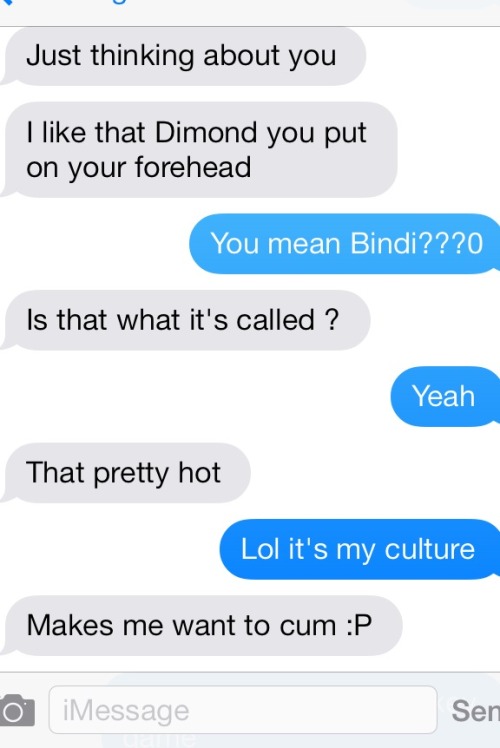
Oftentimes I feel very conflicted when usually white people say they love something about my culture, especially men. I think that there is a stereotype that Asian women are very submissive and docile and I don't think that's true. I found this text and thought it would fit in well with this post: 


To start off, this is absolutely disgusting. If something like this happened to me, I would start feeling like a sex object every time I put on a "dimond". I think that there is a problem with sexualizing Indian culture and Indian women by non-Indian men. 
I feel conflicted because I do think I am mostly "white" on the inside, but having someone reiterate and call attention to my culture, and specifically in a sexual way, unnerves me and makes me uncomfortable. I hate that for some men, I am a fetish and what makes it worse is that I am the typical short Asian with a baby face and shy. They don't like me for me, they like me because they want me to embody the stereotype. 

And yet it is ironic that in my own home, I am desexualized. The Indian-American culture is remarkably similar to the Indian culture, perhaps even more regressive because parents are stuck in the mindset of what India was like 10,15,20 years ago. There is a post on FemWire about this, here is a specific part: 

The concepts of good and bad within Indian society, particularly when it comes to women and girls, are built around virtue. Ahem, chastity. This is widely known to be the case in India itself, where women’s lives and choices are largely restricted and controlled supposedly for their own safety. But in reality, these protections are meant to hinder their sexual freedom, not ensure their overall wellbeing. Similarly, the Indian American community and its values are not far off from this culture. The women are expected to be, and are viewed as, virginal and sexually submissive. The silence around female sexuality – everything from the onset of puberty to reproductive health to attitudes about sexual activity – is common in Indian American homes. And then young people take this with them into their personal and social lives, carrying stigmas about sex and judgment for those who break the rules. In this way, I was able to make the connection, even if only in the periphery of my adolescent mind, about what it was about me that was wrong. The curves of my face, my boisterous personality – versus many other Indian girls’ reserved studiousness – and my avid obsession with making mix tapes off of Hot 97: to other Indians, these things indicated something unrespectable and, indirectly, sexual about me. And it was like a stain that spread over the years.

Women of color were mostly unseen as partner options. And if we landed in the purview somehow, it was, at best, to be mentioned as perhaps pretty and then quickly dismissed (you know, the “Wow, you’re pretty for an Indian girl” line) or, at worst, to be ridiculed for our ugliness. This may sound extreme, but it’s the reality I lived. I undoubtedly stood out in this context – ashy knees in the winter, unruly mane of thick, black hair in a sea of pale midriffs and near-ubiquitous gold or platinum highlights – but I was also invisible. And that external gaze is powerful: the invisibility desexualized me.

After all these years, I’m single for the first time not in a collective setting of a school or university. I’ve finally come to see clearly the odd dichotomy I’ve been navigating of being seen as prudish and puerile and, alternately, overly sensual and almost dangerous because of the ways I step outside of that virtuous Indian woman trope, even if only in the way I speak, carry myself, and dress. I’ve found that I almost always worry that a guy is reading me in one of these two extreme ways. And I do an exhausting dance of guessing which one it is so I can counter it with the appropriate behavior. Only recently did it occur to me that this is not something I can control, that it’s not my fault. That realization in itself is helping me shut out the noise to slowly find the in-between – and with that, my authentic self.

Sexuality does not originate from your body, but the possibility of strange men’s sexuality is constantly in your mind, policing what you wear and how you perceive yourself.

What do you think about this topic? Any commentary or stories? Agree or disagree? Or how is it similar or different being a girl in India? 

Works Cited: 

Growing Up Brown: Desexualized and Hyper-sexualized by Zoya Haroon
(http://feminspire.com/growing-up-brown-desexualized-and-hyper-sexualized/)

Walking the Tightrope: Good Indian Girls, Race, and Bad Sexuality by Chaya Babu

(http://thefeministwire.com/2013/05/walking-the-tightrope-good-indian-girls-race-and-bad-sexuality/)